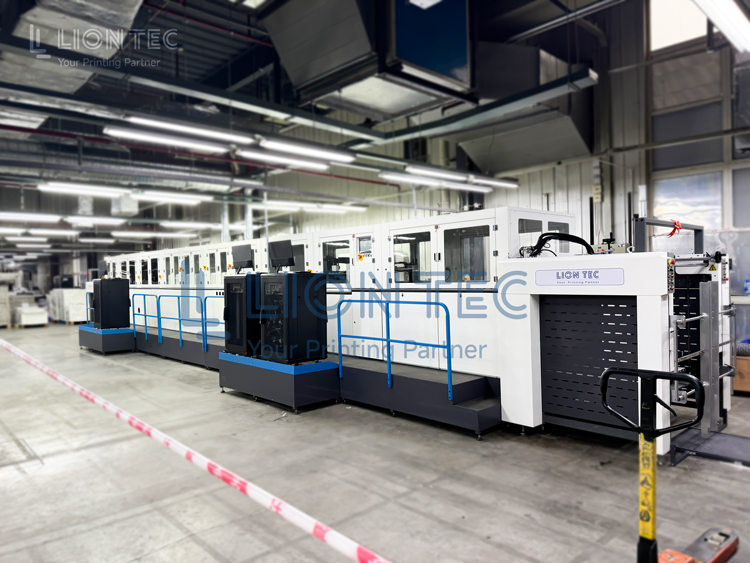
Digging Deep into Underlying Processes, LIONTEC carries out iterative optimization on the core underlying printing workflow of high-speed industrial inkjet equipment. Conventional general-purpose inkjet printers on the market frequently suffer from common defects including paper deformation, unstable ink supply at high running speeds and frequent printing defects. Relying on years of R&D and manufacturing accumulation in industrial inkjet hardware, we target full-link production pain points and realize three pivotal technological innovations, making our equipment perfectly match continuous mass printing production requirements for packaging factories.
Most general-purpose inkjet printers on the market commonly suffer from pain points such as easy paper deformation, unstable ink supply at high speeds, and frequent print defects. With years of in-depth R&D and manufacturing experience in industrial inkjet equipment, LION TEC focuses on pain points across the entire printing workflow to iterate on underlying processes. We have achieved three key technological breakthroughs, addressing the application shortcomings of domestic high-speed inkjet equipment and adapting to continuous, mass production printing scenarios for packaging factories.
1. Self-Developed Water-Based Pigment Ink Technology: Expanding Substrate Compatibility to Meet Low-Temperature Drying and Energy-Saving Needs
Ink is the fundamental factor restricting multi-material printing on high-speed inkjet equipment and also a core R&D focus of LIONTEC over the years. Compared with matching inks for similar foreign inkjet printers, LIONTEC’s self-developed water-based pigment ink offers differentiated advantages in paper compatibility. It enables stable printing directly on four mainstream packaging substrates—coated paper, white cardboard, grey-back white cardboard, and kraft paper—without requiring paper pre-coating. This addresses the common industry pain point of “re-calibrating ink parameters and retrofitting production lines when changing printing materials,” reducing the modification costs for factories to accept flexible orders.
To tackle paper moisture loss and deformation caused by high-speed inline slitting, the brand has achieved bidirectional compatibility between ink formulations and low-temperature drying modules, with differentiated temperature control based on printing speeds: For double offset paper at high-speed inline slitting (150–200 m/min), the drying temperature can be controlled below 120°C; for standard coated paper printing at 80 m/min, the drying temperature does not exceed 160°C. The mild drying mode locks in the basic moisture content inside the paper, reduces rapid water loss from the surface, minimizes paper shrinkage and deformation, lowers the rate of defective products such as edge curling and warping, and ensures basic flatness during post-print slitting.
2. Dual-Loop Ink Supply System: Constant Temperature & Pressure Control to Extend the Service Life of Core Inkjet Printer Components
As the core execution component of industrial inkjet equipment, printheads are prone to image offset and nozzle clogging due to fluctuations in the ink supply environment. To solve the common industry problem of unstable ink supply across the full speed range of 10–200 m/min, LIONTEC has built an independent dual-loop ink supply architecture, separating two independent pipelines for ink supply circulation and printhead temperature control circulation, which operate without mutual interference.
The ink supply circulation dynamically balances the ink pressure inside the pipeline, maintaining stable ink flow and pressure regardless of speed changes, reducing nozzle clogging caused by pigment sedimentation. The printhead temperature control circulation continuously removes excess heat from the printhead, keeping it at a constant operating temperature and preventing droplet placement errors caused by thermal deformation during high-speed operation. Equipped with industrial-grade high-resolution printheads (1200×1200 dpi), the equipment ensures smooth continuous printing through a stable ink supply system, effectively reducing the frequency of daily printhead cleaning and pipeline maintenance, and lowering long-term equipment maintenance consumables and labor costs.
3. Inkjet Compensation Algorithm + Full-Process Control: Eliminating High-Speed Print Defects and Perfecting the Post-Press Integrated Workflow
During high-speed inkjet operations, airflow around the equipment, speed fluctuations, and dot timing deviations can easily cause print defects such as white lines, streaking, local color differences, and scattered ink mist. LIONTEC’s self-developed dynamic inkjet compensation algorithm automatically predicts dot timing and fine-tunes grayscale parameters based on real-time printing speed, matching differentiated dot arrangement logic to different line speeds, thus eliminating print defects at the data transmission level. Equipped with an anti-turbulence droplet module to counteract lateral airflow interference caused by high-speed paper feeding, the system stabilizes the droplet trajectory, resulting in uniform dot reproduction, crisp edges on fine text, and no scattered ink mist on the paper surface.
For post-press integrated supporting processes, LIONTEC has iteratively improved its inline slitting system. First deployed independently in 2019, this system is one of Asia’s earliest self-developed slitting equipment for inkjet printing, breaking the market dominance previously held by European and American manufacturers in digital inkjet post-press slitting solutions, and completing the closed-loop production chain of industrial inkjet printing from printing, drying, cooling to slitting. Meanwhile, the equipment features an integrated ambient cooling station, allowing the dried paper to naturally return to room temperature before slitting, further avoiding secondary deformation caused by temperature differences and ensuring dimensional consistency in mass slitting.
Conclusion
LIONTEC high-speed inkjet equipment leverages three key technological breakthroughs in ink formulation, ink supply hardware, and intelligent algorithms, and has achieved optimized performance in three core application scenarios: direct printing on uncoated coated paper, stable full-speed operation, and low-deformation finished product output. Going forward, the brand will continue to iterate on processes around the specific needs of industrial packaging printing, refine customized supporting solutions for inkjet printers, and help the domestic industrial inkjet printing industry steadily advance its technological upgrade.