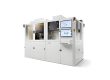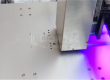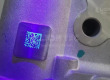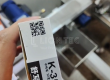
VOC stands for Volatile Organic Compounds, referring to organic chemical substances that easily evaporate into the air at room temperature. Traditional solvent-based coding inks dry through the evaporation of organic solvents. During this process, they release benzene compounds, esters, ketones and other substances, which are the primary source of workshop odors and important precursors for PM2.5 and ozone formation. 0 VOC Eco-friendly Ink for UV Inkjet Printer means an ink type that uses no organic solvents as diluents or carriers in its formula, features nearly 100% solid content, and emits no volatile organic compounds into the atmosphere during printing and curing.
Advantages of Using 0 VOC Ink for Inkjet Marking Machines
1.Improved Workshop Working Environment
Reduce waste gas treatment costs. With no release of volatile organic compounds, workshop odor is greatly reduced. There is no need for complex waste gas collection and purification equipment. It meets occupational health requirements for workshops, suits assembly line production in closed factories, and cuts investment and maintenance costs for environmental protection facilities.
2.Compliance with Domestic and International Environmental Regulations
Smooth factory audit and customer inspection. VOC emissions during production reach compliance standards. For export orders of food packaging, building materials, electroceramics and auto parts, customer audits and third-party environmental tests can be passed more easily. Avoid risks of production shutdown and order rejection caused by excessive waste gas emissions.
3.Enhanced Production Safety
Lower fire control management burden. Containing no volatile organic solvents, it is not classified as flammable hazardous solvent. Fire risks during ink storage and workshop handling are reduced. No special explosion-proof warehouse is required for storage, simplifying warehouse safety management procedures.
4.Stable Curing Speed
Compatible with high-speed production lines. Adopting instant UV curing, marks dry immediately after printing without running or bleeding. Characters and QR codes stay clear under high-speed line conveyance. Products can be stacked and packed right after marking without disrupting production tact time.
Standard Usage of 0 VOC Ink for UV Inkjet Marking Machines
1.Pre-Substrate Sampling Test
Collect substrate samples provided by customers. Print test marks on the UV inkjet marking machine with the same type of 0 VOC ink. Perform adhesion and rub resistance tests after curing. Record curing lamp power and printing distance to verify qualified marking results and judge ink compatibility.
2.Equipment Pipeline Cleaning & Old Ink Draining
Shut down the machine and release pressure. Drain conventional UV ink remaining in pipelines. Use the matched dedicated cleaning fluid to circulate and clean the ink tank, ink supply pump, filter, ink sac and printhead. Repeat flushing until no residual old ink exists in the cleaning fluid to avoid sediment and printhead clogging caused by mixed inks. Drain the cleaning fluid once cleaning finishes.
3.Fill with 0 VOC Eco-friendly Ink & Venting Commissioning
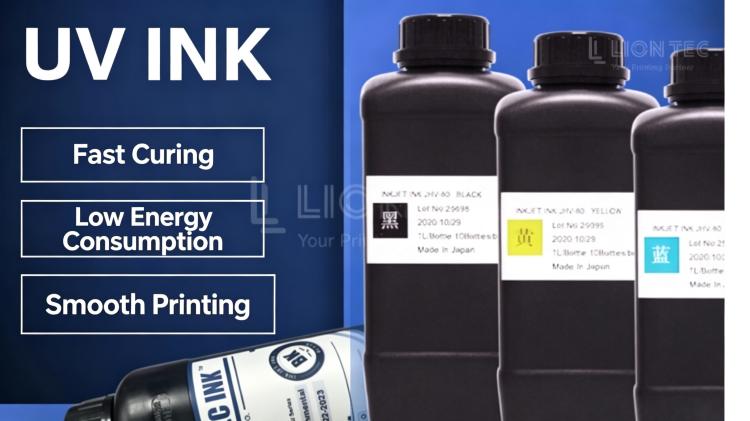
Fill the ink tank with 0 VOC eco-friendly ink. Start the ink circulation system to remove air inside pipelines. Monitor ink viscosity and temperature, set ink supply pressure according to ink manufacturer parameters to stabilize ink circulation. Let it stand for 10–20 minutes to ensure stable ink circuit status.
4. Curing Light Source Parameters & Marking Parameter Setup
Adjust the power of the UV curing lamp according to production line speed and substrate distance. Faster line speed requires higher UV energy. Set printing resolution, droplet size and character spacing, and fine-tune printhead height to avoid ink droplet pulling and scattered dots.
5. Small-Batch Pilot Verification
Start small-batch trial production on the assembly line, continuously print 50–200 products. Check QR code read rate, character clarity and curing completeness. Meanwhile, check for workshop odor and troubleshoot printhead issues such as missing ink or skew printing. Fine-tune parameters until stable performance is achieved.
6. Mass Production & Daily Maintenance
Proceed to mass production after stabilization. Perform simple ink circuit circulation maintenance at the end of daily production, replace filters regularly, keep the printhead moist, and reserve marked samples periodically for subsequent quality traceability.
Conclusion
As a manufacturer of industrial inkjet printing equipment, LIONTEC provides an integrated coding solution with the 0 VOC Eco-friendly Ink for UV Inkjet Printer, covering complete UV inkjet marking machines, supporting 0 VOC eco-friendly ink, free substrate sampling, and on-site installation & commissioning services.