To assess UV coding for Traceability Code for Cosmetic Packaging and see if it can replace self-adhesive labels on cosmetic packaging in 2026, do not focus on the largest numbers on the datasheet. Instead, check three key factors:
- Whether the barcode can consistently achieve a readable grade per ISO/IEC 15416.
- Whether the ink layer on your packaging substrate can pass the cross-cut test and abrasion retest.
- Whether the curing unit retains sufficient margin at your production line speed.
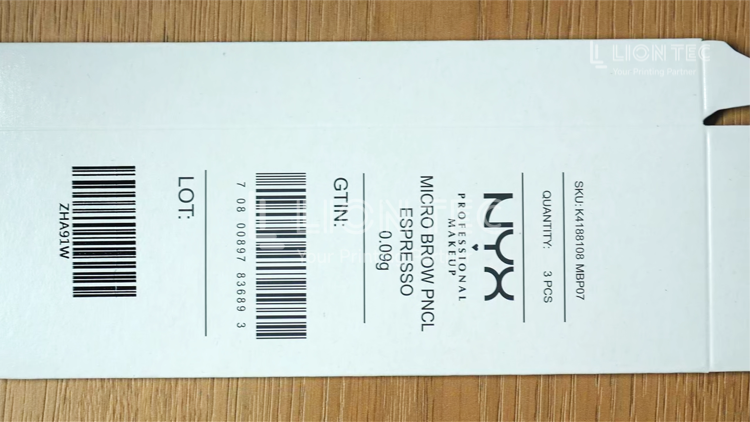
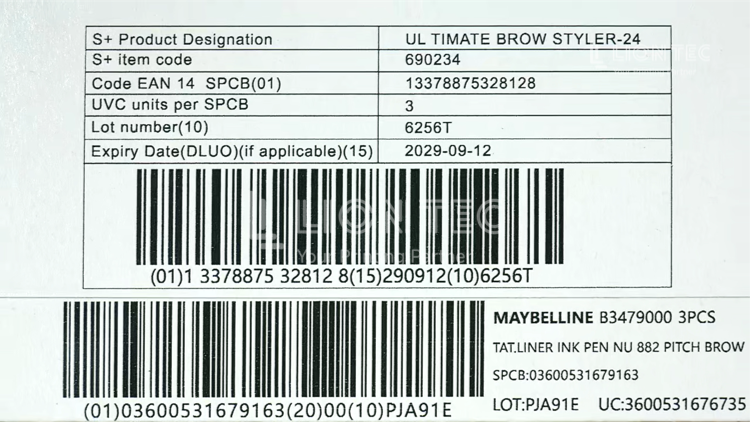
These three items are evaluation criteria, not guaranteed performance values. Whether the replacement works depends on your substrate, line speed and downstream processes, rather than the equipment nameplate. At the laboratory of LIONTEC Printing Technology (Wuxi) Co., Ltd. located in Wuxi, Jiangsu, we have completed sample verification of bar traceability codes on packaging samples from a cosmetic brand under a global top beauty group using the LT‑U series high‑resolution UV inkjet printer.
I. The economics of sticker labels no longer add up in 2026.
For the traceability code on cosmetic outer packaging, most manufacturers still rely on self-adhesive labels. The reasoning is straightforward: labeling is a mature process, labels can be applied as supplied, and defective batches can be replaced easily. But when you calculate the full cost, labels are far more expensive than just the few cents for the label itself.
For a production line using labels, costs fall into at least seven categories: label procurement and minimum order quantities, label inventory and obsolescence, labelling machine depreciation and maintenance, labour at the labelling station, downtime for format changes (required for every new SKU), rework for misaligned or peeling labels, and the hardest cost to quantify — recall and complaint risks triggered by broken traceability chains when labels fall off.
The Measures for the Administration of Cosmetic Labels clearly require cosmetic labels to show the production date and shelf life, or batch number and expiry date. This means coding is not an optional decoration; it is a compliance and traceability requirement. If the code falls off, smudges or becomes unreadable, the business faces regulatory consequences, not just production line issues.
This is where inline UV coding delivers value: it consolidates the two-step workflow of “print labels first, then apply them” into one single step — printing directly onto packaging. The savings go beyond label costs and eliminate the entire intermediate supply chain.
II. Why UV Coding Can Replace Labels: Three Evaluation Dimensions
1. Piezoelectric Drop-on-Demand: Why this technology, not small character coders
The underlying printing technology is Piezoelectric Drop-on-Demand (DoD). Simply put: piezoelectric crystals inside the printhead deform when energized to “push out” ink droplets. No heating or vaporization occurs, and droplet size and placement are controllable. As an analogy, it works like an ultra-fine needle pen that dispenses a fixed volume of ink each time. Continuous inkjet is more like a dripping faucet, deflecting unused droplets into a recovery gutter.
For packaging coding, the key advantage is placement accuracy. Droplets from small character CIJ printers are “thrown”, resulting in coarse dot matrices and ragged bar edges when printing 1D barcodes. Piezo DoD delivers more precise droplet positioning with clean, sharp bar boundaries — this is the physical prerequisite for consistent barcode readability. The required resolution depends on your barcode density and print size, rather than simply chasing higher DPI.
2. Scan Grade: Higher DPI does not guarantee scannable barcodes
This addresses a common misconception: many buyers focus on DPI when selecting coders, assuming higher resolution equals easier scanning. For barcode applications, success is determined by bar width deviation and symbol contrast, not the DPI figure.
1D barcode print quality is graded from A to F under ISO/IEC 15416. It evaluates bar width deviation, edge sharpness, minimum reflectance, symbol contrast and decodability, with the lowest score setting the final grade. Similar to a medical report, it uses the worst result rather than an average; a single failing metric makes the whole barcode non-compliant.
Counterintuitively, darker bars and heavier ink volume may reduce scan grade. Excessive ink causes bar width gain: ink spread widens dark bars and narrows light spaces. Decoders read based on bar-to-space ratios, so any ratio distortion leads to decode failure. Experienced technicians first reduce ink volume then sharpen definition, while beginners often max out ink density and produce “high-resolution” barcodes that cannot be scanned.
The right question to ask suppliers: can you deliver stable ISO/IEC 15416 grades tested on my substrate at my production line speed? This single question quickly distinguishes sales representatives from technical engineers.
3. Adhesion: Bonding depends on surface properties, not material name
Common cosmetic packaging types include laminated cartons, varnished surfaces, plastic bottles, flexible tubes and aluminium foil pouches. In inkjet industry terms, most of these are low surface energy substrates. Simply put, surface energy determines whether liquid can spread and adhere to the surface. Low-surface-energy materials behave like non-stick cookware: water beads up on them, and ink droplets also contract and wipe off easily.
Surface tension (measured in dyn/cm) quantifies this property. It can be tested using dyne pens or by the wetting tension method specified in GB/T 14216. The workflow is: first measure the dyne level of your packaging surface, then select ink and pre-treatment accordingly. Direct printing is feasible above the threshold value. Below the threshold, corona treatment, plasma treatment, primer coating or custom-formulated ink will be required. This threshold is tied to ink formulation — this is the real technical differentiator between vendors. Printheads are widely available, but custom ink formulas engineered for low-surface-energy substrates are proprietary.
Validation also follows a clear process: adhesion is assessed via the cross-cut test according to GB/T 9286, then abrasion resistance is tested under simulated distribution conditions. One frequently overlooked step: the cross-cut test only checks whether the coating peels, it does not verify barcode scannability. You must re-scan the barcode after abrasion testing. A test without post-abrasion scanning is incomplete.
III. How Sample Testing & Verification Works
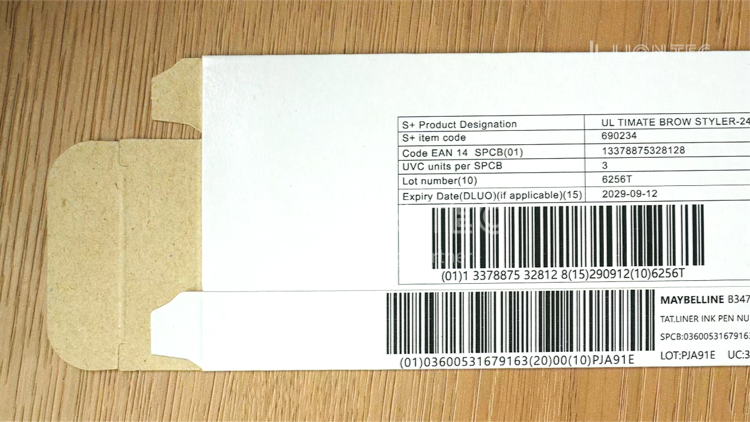
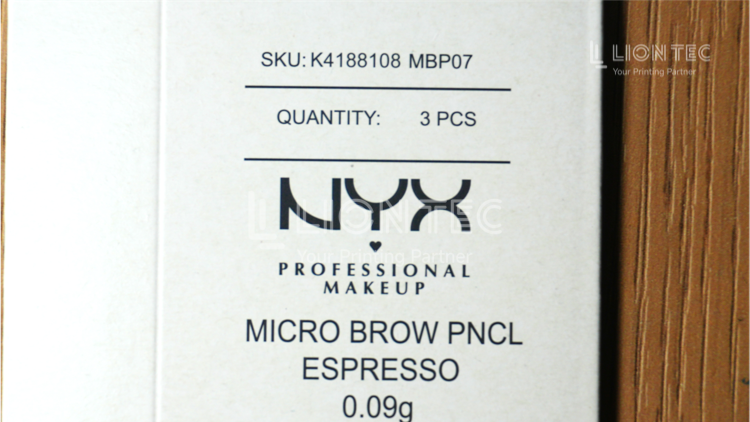
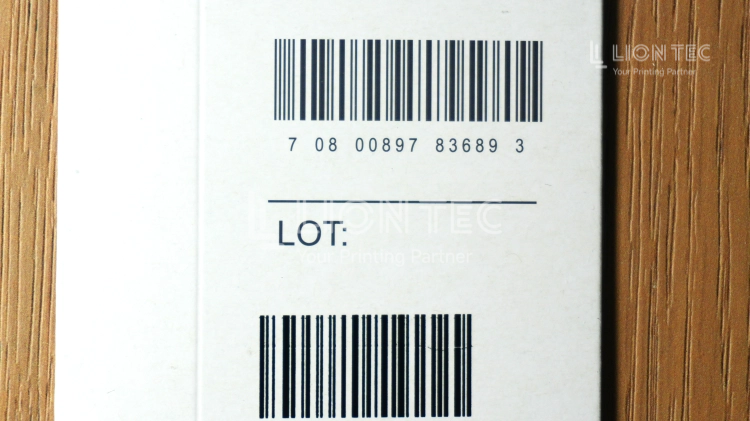
The samples submitted for this test are cosmetic packaging from a global leading beauty group, coded with linear traceability codes plus variable batch and expiry date data. The test consists of four stages:
Substrate Assessment: First measure the dyne level and surface condition of the packaging to confirm whether pre-treatment is required. Skipping this step guarantees rework downstream.
Ink Selection: Match the UV ink formulation to the substrate. For low-surface-energy materials, adhesion takes priority over colour performance.
Parameter Tuning: Adjust ink volume, bar width compensation and curing power. Repeated test prints are carried out until consistent, stable scan results are achieved — this stage often requires dozens of iterations.
Verification & Re-testing: Initial barcode scan → cross-cut / abrasion test → re-scan after testing. If the barcode fails the final scan, the earlier two checks are meaningless.
This sample validation delivers a directional conclusion: on this type of cosmetic packaging, UV coding passes laboratory assessment for readability, adhesion and curing, making it technically viable to replace self-adhesive labels. Whether a production line can switch over and the corresponding cost savings depend on three variables: substrate surface energy, production line speed and downstream process conditions. Any performance figures without on-site validation are only estimates.
To clarify: this is a laboratory sample test result, not production line performance. Good print quality in the lab is not equivalent to months of stable continuous operation on the customer’s production line. On-site process validation is mandatory before full production launch and cannot be omitted.
IV. Scenarios Where We Do Not Recommend Label Replacement
1.The packaging surface energy is extremely low and pre-treatment cannot be integrated into the production line.
There are many types of laminated films. Some film surfaces fall below the threshold for direct printing, and corona treatment cannot be added conveniently. Forced coding carries a high risk of poor ink adhesion.
2.The available coding area is too small.
When the printable area for the barcode is squeezed to the limit of bar width, stable scan grades are hard to maintain, and labels become more reliable instead. The minimum feasible size depends on barcode density and scanner hardware and requires actual testing.
3.Downstream processes involve high temperature, retort sterilization, deep freezing or heavy abrasion.
Heat shrinkage, retort sterilization and frozen transport challenge the ink layer’s temperature and abrasion resistance. Separate process validation is required; room-temperature lab test results cannot be applied directly.
4.One additional case deserves special attention.
Do not rush into inline coding before finalizing packaging artwork. Printing zones must be reserved at the design stage, avoiding varnished and embossed areas. Once the design is locked without reserved space, label application is often the only fallback option.
V. Structural Differences Between the Two Solutions
| Comparison Item | Self-Adhesive Label Solution | LT Series UV Coding Solution |
|---|---|---|
| Marking Formation | Labels printed by printing house → warehousing → applied by labelling machine | Direct in-line printing on packaging as it passes through |
| Changeover Response | Reorder new plates and stop the line for label replacement | Modify template in software, switch within minutes |
| Cost Structure | Dominated by variable costs: label and labour expenses rise with output | Dominated by equipment depreciation; extremely low marginal cost, unit cost decreases as volume increases |
| Coding Content | Mainly fixed content; variable data must be pre-printed | Supports inline variable data printing, one unique code per item |
| Flexibility | Label rework required for code changes, limited by stock and lead time | Adjust code via template, adaptable to batch rules |
| Environmental Performance | Generates release liner waste and label scraps | Zero-VOC UV ink (compliant with relevant limits of GB 38507-2020), no release liner waste |
| Main Risks | Lifting, peeling, misalignment, production downtime | Substrate adhesion, curing margin, stability of scan grade |
For cost calculation, we prefer to provide you with a calculation framework rather than fixed figures: break down both solutions into variable cost + fixed cost. Input your production capacity, batch frequency and unit labor cost, and you will get your own conclusion.
In short, the UV printing solution delivers greater structural advantages when you have large production capacity, numerous SKUs and frequent artwork changes. Conversely, label application tends to be more cost-effective for low-volume runs, few SKUs and packaging designs that remain unchanged for long periods.
VI. Five Technical Parameters to Be Specified in the Procurement Contract
1.Scan Grade and Test Method
Specify testing in accordance with ISO/IEC 15416, target grade, sampling quantity and model of test equipment. “Legible to naked eye” shall not be accepted as acceptance criteria.
2.Adhesion Test Method
Specify the grading requirement per GB/T 9286 cross-cut test. Add an extra clause: the barcode remains scannable after wiping under simulated distribution environment.
3.Curing Margin at Your Production Line Speed
State: No sticking or smudging upon immediate stacking after curing at the line speed of xx m/min. Do not quote the “maximum speed of the equipment”.
4.Substrate Compatibility List and Surface Energy Threshold
List all packaging materials you actually use in the contract appendix, and specify dyne level requirements and the responsible party for pre-treatment.
5.Ink VOC Index and Test Basis
Specify compliance with the corresponding category limit values in GB 38507-2020, and require submission of a third-party test report.
VII. Frequently Asked Questions
1.Can UV coding be printed on laminated color boxes?
Mostly yes, but it depends on the surface energy of the film rather than the term “laminated film”. The evaluation method is to first test the dyne level and then select ink: direct printing is feasible if the value is above the threshold; if below the threshold, corona or plasma pre-treatment or custom-formulated ink will be required. Sending samples for testing is faster than checking documents.
2.Can the printed barcode be scanned? How to verify it?
Verify grading per ISO/IEC 15416 (Grade A to F). The final grade is determined by the lowest index among all parameters. Note that a darker barcode does not mean better performance. Excessive ink volume causes bar width gain and downgrades the grade. A qualified solution is judged by stable repeatable grade under your production conditions, not just a one-off good test result.
3.Which is cheaper, UV coding or label application?
Calculate based on comprehensive cost per mark, not only label unit price. Labeling costs rise with output (procurement, inventory, labeller, labor, changeover downtime and rework). The coding solution is dominated by equipment depreciation with very low marginal cost. Its advantages become more prominent with higher production volume and more SKUs. Input your own capacity and labor cost for a conclusion more accurate than any quotation.
4.Is UV ink for cosmetic packaging environmentally compliant?
LIONTEC UV ink adopts a zero-VOC formula, complying with the corresponding category limits specified in GB 38507-2020 Limits of Volatile Organic Compound Content in Inks. The applicable categories and limit values are subject to the standard text and third-party test reports. You may request test reports during procurement.
5.Can it connect to our existing traceability system?
Yes. LIONTEC self-developed inkjet control software (Suanni) supports external data sources and industrial protocol communication. Printing content can be issued from MES / traceability platforms to realize one-item-one-code and anti-parallel import. The interface protocol shall be confirmed in the solution phase.
6.Has this solution been running on customer production lines?
We have completed laboratory sample verification. The samples have passed assessment in three aspects: readability, adhesion and curing. Further on-site testing is required to confirm feasibility before deployment on production lines, according to your actual working conditions.
Conclusion
Whether to keep applying labels for traceability codes appears to be a process choice, but essentially it comes down to whether your business wants to bring packaging coding in-house. If you bring it in-house, version changes, code modifications and traceability data stay fully under your control. If not, you will keep bearing costs for label procurement, inventory and production downtime.
If you are considering this transition for your packaging, you may send samples to the LIONTEC laboratory. We will conduct sample validation following the above procedure and test the three evaluation criteria one by one for you. Whether the replacement works will be determined after testing.