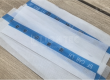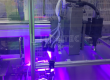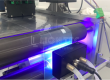
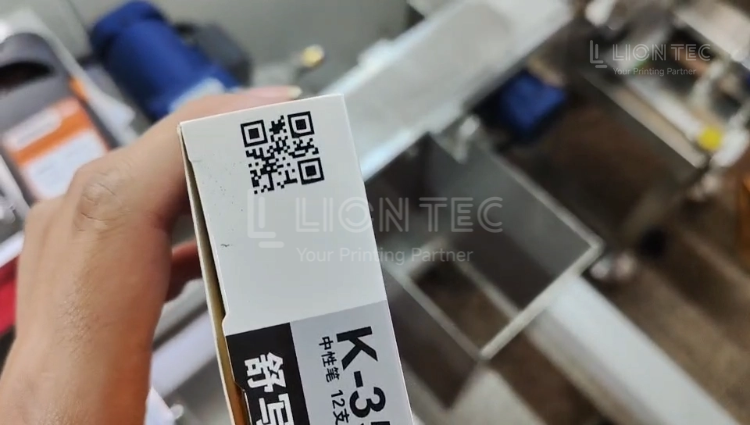
In the field of packaging marking, One Pass Inkjet Printer on paper and cardstock materials has long faced a core contradiction: production lines need higher speed while curing must keep pace. When line speed increases, incomplete ink curing causes smudged marks. If curing is strengthened, the production line has to slow down, hurting productivity. While serving customers in food packaging, daily chemical cartons, and 3C color boxes, LIONTEC has built a systematic control solution for this challenge with our One Pass Inkjet Printer.
High-speed Inkjet Printing & Curing Control
This workflow is LIONTEC’s standard on-site commissioning procedure for delivery, applicable to roll paper and single-sheet feeder cardstock production lines.
Ⅰ. Substrate Sampling & Basic Parameter Collection
Confirm cardstock type and basis weight, test paper surface tension with dyne pens, record target line speed, printing content and printing width, and verify printhead configuration and UV lamp installation position for the One Pass Inkjet Printer.
Ⅱ. Synchronization Calibration of High-speed Inkjet System
Connect the production line encoder to establish synchronization between paper feeding speed and inkjet triggering. Set jetting frequency and droplet size; prioritize small droplets in high-speed scenarios to reduce ink layer thickness. Print multiple consecutive test samples, check for character horizontal drift, ghosting and droplet splashing, and fine-tune printing delay to ensure position consistency across different paper spacings.
Ⅲ. Curing System Hardware Position & Basic Settings
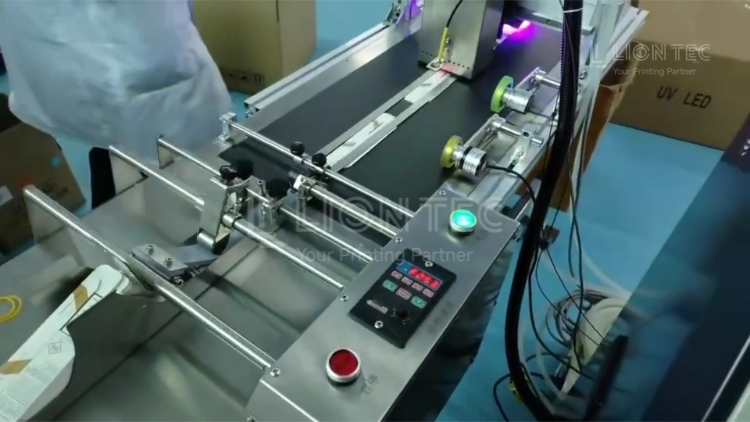
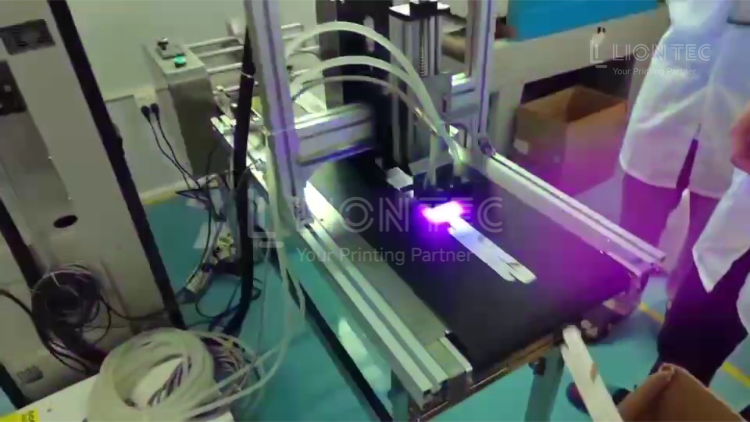
Install UV LED lamps downstream of the printheads, fix the distance between printheads and lamp heads, enable air-cooling, set lamp body temperature protection thresholds, select the light source wavelength matching the ink, turn off redundant lamp groups, and activate only the light source corresponding to the printing width to reduce excess heat.
Ⅳ. Gradient Curing Energy Commissioning
Start at low power and gradually increase the UV lamp power. Print test samples at each parameter segment. After the samples cool down, perform two inspections: ① Tactile test to confirm the ink layer is non-tacky; ② Alcohol abrasion rubbing test. Acceptance criteria: ink cannot be wiped off. Meanwhile, check if the cardstock shows yellowing or warpage. Find the optimal curing energy range corresponding to the speed and avoid excess energy for the One Pass Inkjet Printer.
Ⅴ. Linkage Matching & Maximum Speed Verification
Fix the curing parameters and gradually raise the paper feed speed of the production line. Fine-tune curing energy compensation synchronously at each speed increment. Continuously print ≥20 cardstock samples, inspect barcode readability grade, ink adhesion and paper deformation to confirm the stable operating window.
Ⅵ. Parameter Archiving & Mass Production Inspection Rules
After successful commissioning, name and archive the full set of parameters as a dedicated process formula for this cardstock, which can be directly recalled when switching paper materials. During mass production, take samples every 2 hours to recheck curing performance and barcode scan rate, record ambient temperature and humidity changes, fine-tune curing parameters when necessary, and build a process log.
Ⅶ. Daily Maintenance for Consistent Curing Stability
Regularly clean the UV lamp reflector, monitor LED light attenuation, and inspect the negative-pressure ink circuit to prevent ink atomization from contaminating the lamp surface. When there is a batch change of incoming cardstock materials, a small sample test must be carried out first to verify printing and curing results before mass production startup.
Benefits of Inkjet Printing & Curing
1. Improve Production Line Efficiency & Match Downstream Processes
Enables high-speed continuous inkjet printing without waiting for natural ink drying. Printed products can be immediately stacked, die-cut and laminated, eliminating the buffer stations required for traditional water-based / solvent coding to dry, and fully synchronizing the takt time of the entire packaging line.
2. Reduce Defect Rate & Stabilize Variable Code Readability
Linked control of printing and curing reduces code smudging, paper sticking, barcode edge blurring and local incomplete curing. QR code / 1D barcode grading remains stable, significantly reducing entire batches of cardstock scrap caused by failed coding and cutting rework labor costs.
3. Protect Cardstock Substrate & Adapt to High-end Packaging
The UV LED cold-light source curing solution features precise temperature control, reducing paper thermal deformation, yellowing and warping. It is suitable for paper packaging with strict appearance requirements such as color boxes, gift cardstock and clothing hang tags, ensuring stable finished product appearance quality.
4. Save Energy & Consumables & Extend Equipment Lifespan
The curing system automatically adjusts light output based on paper presence, and automatically reduces power during paper-free standby. Reasonable curing parameters reduce printhead clogging and ink waste, while UV lamp light attenuation is more stable, extending the service cycle of core components such as LED lamps and printheads.
Conclusion
As a manufacturer of industrial inkjet printing equipment, LIONTEC can assist customers with paper/cardstock UV Inkjet Printer selection, sample testing and production line parameter optimization. If you need solution evaluation for specific substrates and production line speeds, feel free to contact the LIONTEC technical team for support.