Aluminum foil and composite films occupy an irreplaceable position in food, pharmaceutical and daily chemical packaging. However, many enterprises often encounter a common challenge after introducing UV coders to their production lines: the printed codes look fine right after marking, but they can be easily wiped off after folding, friction or low-temperature storage, and this is not a problem with equipment precision, but a failure to solve the “adhesion bottleneck” between ink and substrate, which is exactly what LIONTEC’s UV Coding Printing Solution targets for flexible packaging materials.
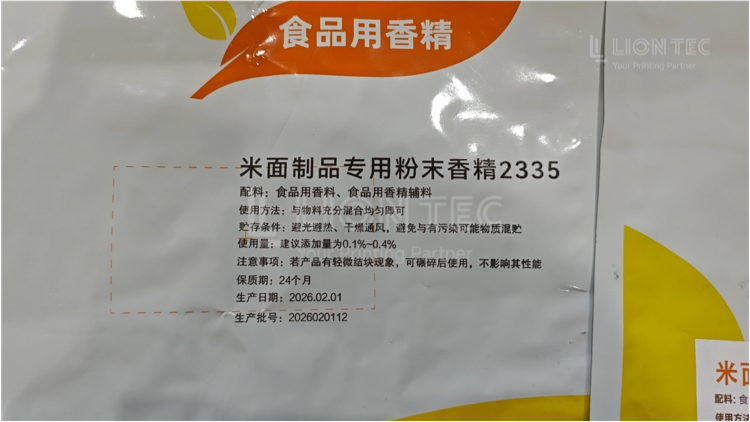
High-Adhesion Printing Solution
Ⅰ. Substrate Incoming Inspection & Evaluation
- Take samples of aluminum foil / composite film for actual production, test surface dyne value, and check for rolling oil, release agent and dust on the surface.
- Confirm production line type, intermittent blister line / continuous roll-to-roll bag-making line, and record production speed.
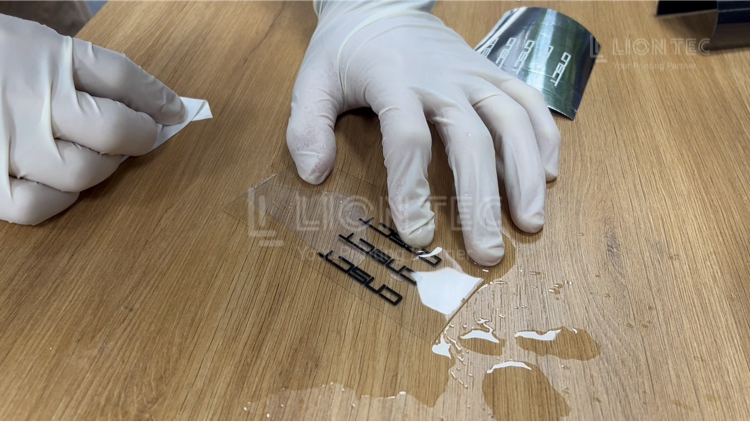
- Confirm test standards including cross-hatch test, 95% alcohol wipe cycles, bending requirements and retort resistance conditions, and define acceptance indicators.
Ⅱ. Select Appropriate Pre-treatment Process to Improve Substrate Surface Energy
- For mass production of ordinary composite films and aluminized films, adopt corona treatment unit to raise substrate dyne value to 42-52dyn/cm, suitable for most food packaging scenarios.
- For pharmaceutical clean workshops and bare bright aluminum foil, plasma surface activation treatment is preferred for uniform activation without massive ozone residue.
- For extremely hard-to-adhere substrates, special primer coating process can be matched.
- Complete printing within 24 hours after pre-treatment; surface activity and adhesion will decline if stored too long. If incoming substrates have heavy oil contamination, add dust removal and isopropanol wiping cleaning stations to eliminate isolation layer.
Ⅲ. Ink Model Matching
- Abandon general UV ink and adopt modified UV high-adhesion ink for aluminum foil composite film. The ink formula contains silane coupling groups, adapting to metal-plastic composite interfaces.
- For pharmaceutical and food contact scenarios, select ink of corresponding compliance grade. Do not mix different series of ink to prevent printhead clogging and abnormal curing.
LIONTEC’s UV Coding Printing Solution covers the full workflow above to achieve stable high-adhesion marking on aluminum foil and composite flexible packaging.
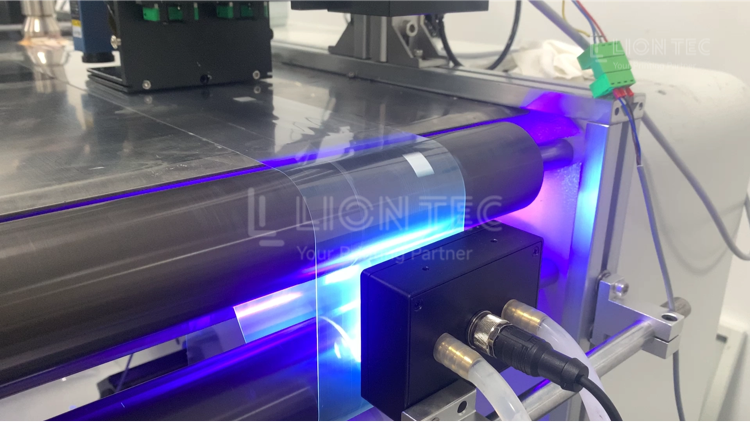
Ⅳ. Hardware and Mechanism Commissioning of UV Coding Equipment
- Printhead selection: Piezoelectric UV printhead with variable droplet output. Maintain 1-3mm distance between printhead and substrate.
- Ink layer thickness control: Insufficient ink thickness leads to poor adhesion; excessive thickness causes cracking after bending.
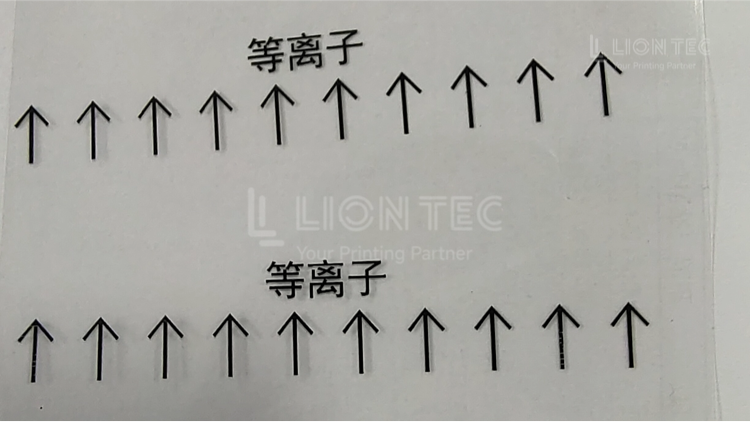
- Add anti-static module to production line. Aluminum foil composite film easily accumulates static electricity during high-speed feeding, which causes ink droplet scattering and hollow printing spots. LIONTEC’s UV Coding Printing Solution is equipped with ion air to eliminate static interference.
- Feeding tension control: Enable dynamic tension compensation for roll film production lines to avoid ghosting and marking position offset caused by film shaking.
Ⅴ. Parameter Calibration of UV-LED Curing System
- The wavelength of the light source matches the photoinitiator in the ink.
- Curing energy is controlled at 500-1000mJ/cm². Power cannot be too low (incomplete curing leads to ink falling off), nor too high (rapid surface sealing with insufficient cross-linking at bottom layer, resulting in later peeling).
- Complete curing immediately after printing. Arrange printheads and curing lamps at a reasonable distance to prevent UV light reflection from damaging printheads.
- Keep production environment temperature at 20-25℃ and relative humidity at 40-60% to reduce environmental interference.
Ⅵ. Offline Adhesion Verification and Curing Aging Confirmation
- Perform immediate test right after printing.
- The internal cross-linking of UV ink layer continues. It is recommended to recheck adhesion after 24 hours, and take the 24-hour retest result as the final acceptance standard, to avoid the false impression that marks pass immediately after printing but peel off during storage.
Ⅶ. Small-batch Trial Production and Curing Production Line Process SOP
- Carry out small-batch feeding, continuously track the adhesion stability of 5000-10000 pieces of products.
- Record pretreatment power, printhead parameters, curing energy and production line speed, and output standardized SOP.
- Adhesion must be reconfirmed when switching substrate batches.
Benefits Delivered by High-Adhesion Solution
- Durable & Reliable Marking Avoid the risk of traceability failure. After cross-hatch test, alcohol wipe test and repeated bending test, the printed QR codes and batch numbers are resistant to peeling. For pharmaceutical, lithium battery and retort food applications, the marks remain intact after subsequent heat sealing, retort sterilization and rough transportation, reducing losses caused by returned goods and failed product traceability due to falling-off marks.
- Compatible with High-speed Automated Production Lines High production efficiency. UV ink achieves instant curing via UV-LED, supporting high-speed linkage with roll-to-roll machines, blister packaging machines and bag-making machines. No drying waiting time required, no ink bleeding or packaging smudging from solvent inks. Compared with thermal transfer and CIJ small-character coding, it delivers 600dpi high-definition output with stable recognition rate for tiny QR codes and fine texts.
- Compatible with Multiple Composite Substrates Lower production line modification cost. One single solution covers pure aluminum foil, aluminum-plastic composite film, metallized film and multi-layer flexible packaging films. LIONTEC’s UV Coding Printing Solution can directly connect to existing packaging equipment and support additional pre-treatment modules, without large-scale replacement of original production hardware. Food and pharmaceutical compliant grade inks are available to meet industrial compliance requirements.
- Comprehensive Operation & Maintenance Advantages, UV Ink Free of Volatile Solvents Lower VOC in workshops. Piezo printhead variable droplet technology enables controllable ink layer thickness and cuts ink consumption waste. Compared with conventional label application, it saves the cost of label materials and maintenance for labeling machinery.
Closing Remarks:
The adhesion of aluminum foil and composite film is greatly affected by material formulation, additives and production batches. Before formal procurement and commissioning, we recommend sending actual substrate samples for sampling and testing. The physical sampling test results shall be taken as the basis for solution selection, and LIONTEC’s UV Coding Printing Solution will be customized accordingly.