When marking on non-woven fabrics, common problems including bleeding text, blurred edges and unreadable QR codes do not originate from the UV Inkjet Marking Machine itself. The root cause lies in the compatibility between ink and porous non-woven substrate.
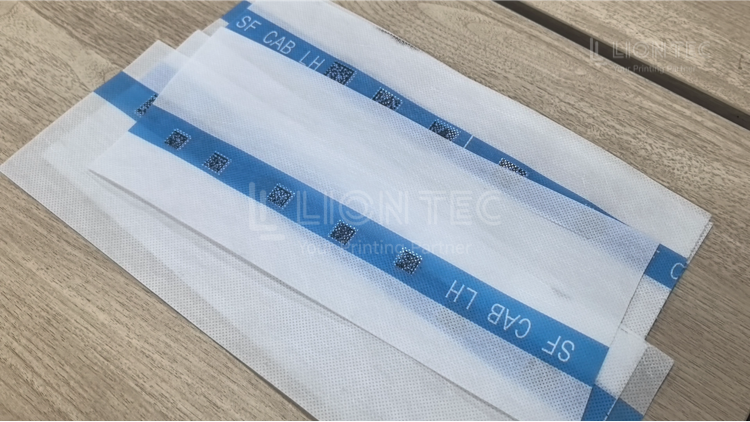
Non-woven Fabric Anti-penetration Inkjet Printing
1.Substrate Property Testing & Sample Evaluation
Take actual non-woven fabric samples from customers, confirm material type (PP spunbond / hydroentangled / needle-punched), basis weight and porosity. Test substrate surface tension with dyne pens, record production line speed, printing content (text / QR codes) and acceptance criteria, and determine whether corona pretreatment or primer coating is required for the UV Inkjet Marking Machine.
2.Ink Selection & Matching
Select LIONTEC special anti-penetration UV ink according to the porosity grade of non-woven fabrics. For loose and porous non-woven fabrics, use high-lock, low-diffusion formulations. For dense non-woven fabrics, adopt UV ink with balanced flexibility. General-purpose UV ink cannot be used directly.
3.Equipment Hardware Installation & Mechanical Calibration
Install high-resolution piezoelectric printheads and short-distance UVLED low-temperature curing modules for the UV Inkjet Marking Machine. Adjust printhead height to maintain a constant distance between printheads and non-woven fabric surface. Install roll tension control and encoder synchronization modules to suppress printing offset caused by fabric shake and wrinkles.
4.Substrate Pretreatment (Enable as required)
Equip low-surface-energy PP non-woven fabrics with a corona treatment unit to raise surface tension. For non-woven fabrics with extra-large pores, a thin primer coating can be matched to seal large surface pores and reduce ink absorption effect.
5.Printing Parameter Commissioning
Set proper ink droplet size, firing voltage and dot matrix density. Control the distance from ink droplet landing point to UV lamp, shorten interval time, and adjust UVLED optical power to ensure sufficient cross-linking and curing of ink, avoiding insufficient curing adhesion and migration.
6.Sample Performance Inspection
Visually check for halo and backside ink penetration, test QR code reading rate, tape adhesion test and abrasion resistance test. Pilot production can only be carried out after all indicators meet standards.
7.Pilot Production & Archiving of Mass Production Curing Parameters
Continuously monitor marking status during small-batch pilot production, fine-tune parameters according to workshop temperature and humidity, and archive this set of anti-penetration parameters. The parameters can be directly applied for subsequent non-woven fabrics of the same batch to reduce repeated commissioning.
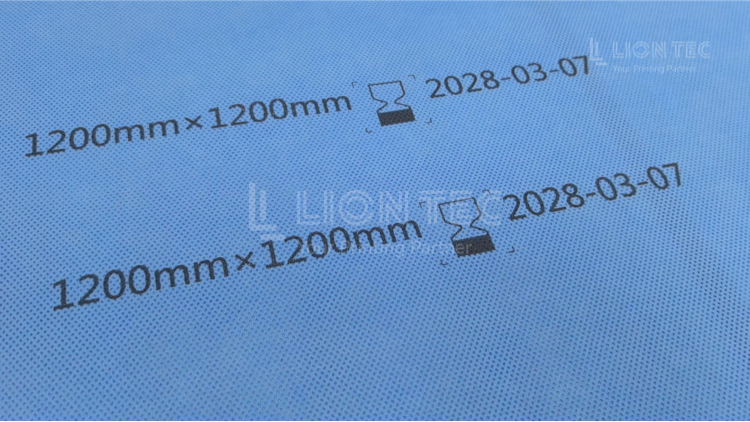
Benefits of Anti-penetration Inkjet Printing on Non-woven Fabrics
1.Stable Mark Readability & Lower Traceability Defect Rate
The UV Inkjet Marking Machine delivers QR codes, barcodes and texts with sharp edges without haloing, burrs or backside ink penetration. It maintains a stable scanning pass rate, meets full-process product traceability requirements for medical and filter materials, and reduces defective losses caused by blurred marks.
2.Preserve the Original Properties of Non-woven Substrates
Adopting low-temperature UVLED curing, the UV Inkjet Marking Machine avoids shrinkage and deformation of PP non-woven fabrics caused by high-temperature baking. The anti-penetration ink film only adheres to the surface layer without blocking the micropores of non-woven fabrics, preserving basic fabric functions such as air permeability and filtration.
3.Durable Coding Marks Compatible with Post-processing
An elastic ink film forms after curing. The marks remain intact when the non-woven fabric is folded or stretched. They feature friction resistance and moisture resistance. For some medical applications, the marks can survive sterilization processes. With low VOC, they comply with environmental requirements for hygienic materials.
4.Continuous On-line Production & Reduced Downtime for Commissioning
The complete anti-penetration solution of the UV Inkjet Marking Machine is suitable for roll-to-roll online printing. After commissioning, it supports long-term stable mass production and cuts down man-hours for parameter re-adjustment and printhead maintenance from frequent material changes.
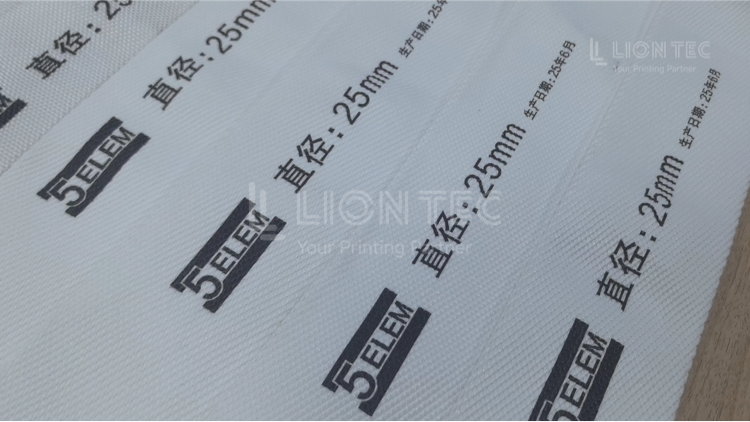
Conclusion
Since 2014, LIONTEC has focused on industrial fine inkjet technology and boasts full-stack capabilities covering image processing, ink circuit design and ink formulation development. For anti-penetration printing demands on non-woven fabrics, we can deliver customized solutions including equipment selection, ink matching and on-site commissioning for your UV Inkjet Marking Machine, tailored to specific material properties and production line conditions.